Introduction
As parents, we’ve all experienced those challenging moments—your child throws a toy across the room, refuses to follow instructions, screams in the supermarket, or suddenly melts down over what seems like a small problem. It’s easy to feel frustrated or wonder, “Why are they behaving like this?” Often, these behaviours are labelled as “naughty,” “attention-seeking,” or “bad.”
But as speech pathologists, we encourage families to look a little deeper and do some detective work to determine the ‘WHY’ behind the behaviour.
Behaviour Is a Form of Communication

Behaviour is one of the many ways children communicate. When children don’t yet have the language, emotional awareness, or self-regulation skills to express what they are experiencing, their behaviour often becomes their ‘voice’.
By understanding ‘WHAT’ a child may be trying to communicate, we can respond in ways that support their development rather than simply reacting to the behaviour itself. Consider behaviours as purposeful and intentional. Children behave in certain ways because they are trying to communicate a need, emotion, or experience that they may not have the language or words to express. For example, your child may be communicating “I’m feeling overwhelmed” by running away from the setting or situation they are in. Also, your child may be communicating “I’m frustrated because this toy doesn’t work” by throwing the toy.
Children are not born knowing how to identify and explain their feelings. These skills develop over time through sharing personal experiences, and learning how to label, identify and explain how we are feeling.
When Words Are Hard, Behaviour Speaks
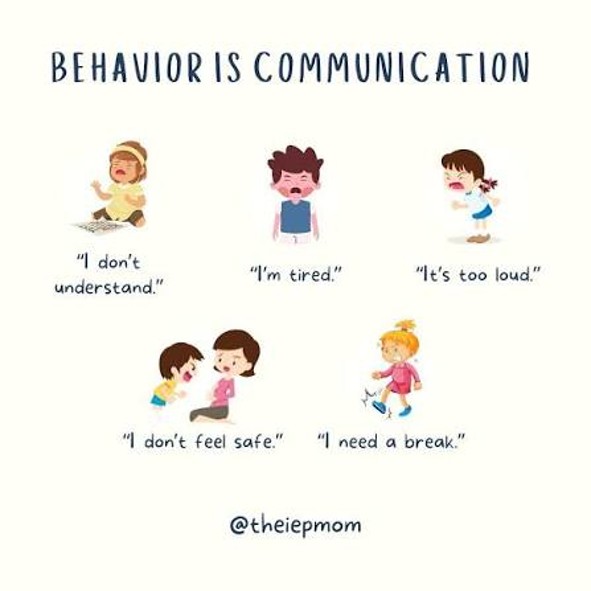
Many children experience moments when their language cannot keep up with their emotions. Imagine feeling anxious, overwhelmed, or frustrated but not having the vocabulary to explain it. For young children, or children with communication differences, this is a daily challenge.
- Instead of saying, “I can’t cope with change” – a child might cry, yell, or refuse to move.
- Instead of saying, “It is too loud” – a child may cover their ears, run away, or have a meltdown.
The behaviour may seem challenging on the surface, but detective work into the context and situation will give you more clues in what their behaviour is communicating.
What Can Parents Do?
Rather than trying to stop the behaviour on the surface, do a little more detective work to find out the underlying message because behaviour communicates. Start asking, “what is my child trying to communicate in this behaviour?” and use clues in the situation or context to help you determine how your child is feeling.
In these challenging moments, it is important to remain calm and help your child feel regulated before you can help them problem solve. Acknowledge your child’s feelings and use simple language to label the emotions they are displaying through their behaviour. For example, if your child is yelling, instead of saying “stop yelling!”, you might say “I know you are feeling angry, It’s okay to feel angry. Let’s take a deep breath so our body can feel good again.” This doesn’t mean we allow unsafe behaviour to occur, but we also want to determine the ‘WHY’ behind the behaviour and ‘WHAT’ the behaviour is communicating.
 Conclusion
 Conclusion
Behaviour is often the tip of the iceberg and the ‘loudest’ message a child communicates. What we see on the outside may be frustration, avoidance, or anger, but underneath there may be confusion, anxiety or cognitive overload and they just don’t have the words or language to communicate these big feelings.
By shifting the view and looking beyond “bad behaviour” to behaviour is communication, we create opportunities to model how to label feelings and emotions, and support children develop strategies to communicate their feelings and emotions effectively with others. Every challenging moment becomes a chance to build emotional understanding and communication skills. So, remember the next time your child displays challenging behaviours, pause and ask yourself: “What might they be trying to tell me?”