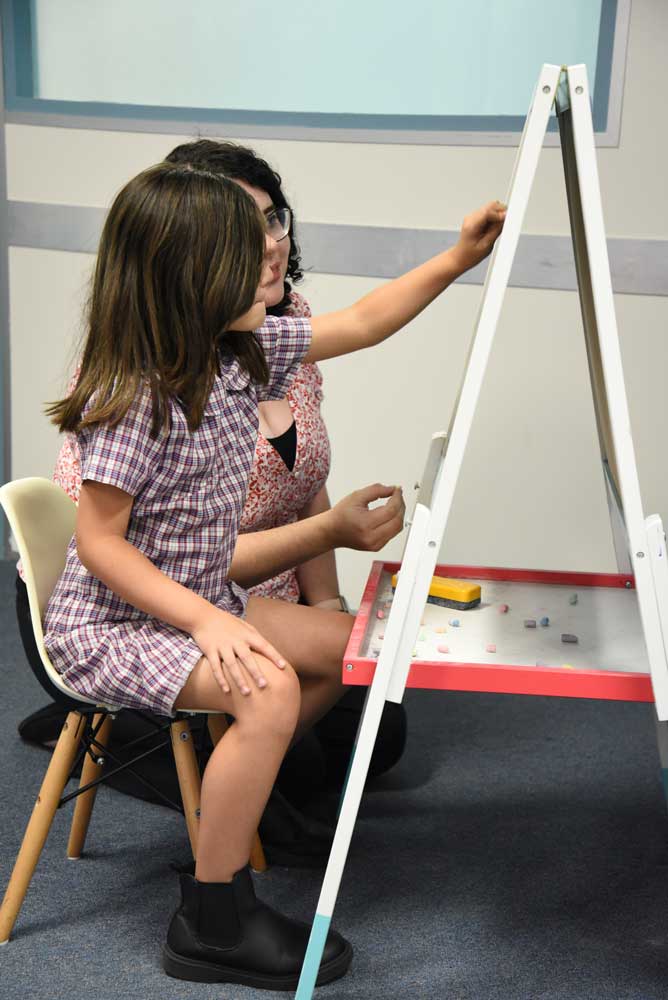
“Articulation therapy by itself will not generalise if the lingual rest posture remains low and forward. If you’re up high, that’s where you start. If you’re down low, that’s where you start.” — Linda D’Onofrio, Speech Pathologist
We’ve all seen it. A child produces a beautiful /s/ in the therapy room — clear, precise, exactly right. Then they walk out the room, have a conversation with a parent or sibling, and the interdental lisp is back. Before we attribute this to insufficient home practice or lack of carry-over effort, it’s worth asking a more fundamental question: where is that child’s tongue resting for most of the day?
Lingual rest posture is not a peripheral concern
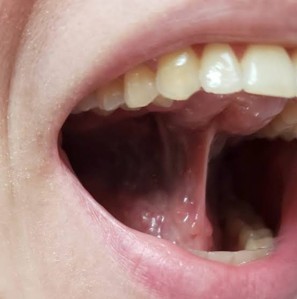
Where the tongue habitually rests matters more than what it does during a brief, structured therapy task. A low, forward resting posture isn’t simply a speech issue — it exerts influence across multiple systems:
- Dental development: Our facial muscles continue to grow throughout childhood, into adolescence. As they grow, the muscles around the mouth and face gently press inward on the upper jaw and palate. When the tongue sits low, on the floor of the mouth, there is nothing to counteract that internal pressure and the palate often narrows, contributing to dental crowding and malocclusion.
- Breathing pattern: When the tongue rests on the floor of the mouth, the mouth tends to fall open, favouring oral over nasal breathing — with well-documented downstream effects on airway health, sleep, and craniofacial development.
- Swallowing: A child swallows between 500 and 700 times a day. When the tongue rests low and forward, that posture is almost invariably carried into the swallow pattern, perpetuating a tongue thrust.
- Speech production: When a child begins speaking from a low, forward position, the target sounds — particularly /s/ and /z/ — will consistently emerge from that same starting point.
A few minutes of correct placement in the therapy room cannot easily undo the cumulative effect of hours of low, forward tongue positioning throughout the day.
Why correct /s/ production fails to generalise

Articulation therapy is essential — but when rest posture goes unaddressed, we risk working only at the surface level. The brain defaults to what it knows best. If the tongue’s habitual resting position is low and forward, that is the starting position from which speech will emerge, regardless of how well-drilled the target sound is in structured tasks.
Correct /s/ production relies on lateral tongue bracing — the sides of the tongue contacting the inner surfaces of the upper molars — with a central groove formed to direct airflow. When the tongue is resting correctly on the palate, the lateral margins are in contact with the upper molars. In other words, the resting posture and the articulatory posture are functionally related.
When the tongue rests low and forward, there is no lateral contact. The starting position for speech is biomechanically compromised from the outset. Even when a child achieves consistent, accurate production in structured activities, generalisation to connected speech will remain elusive if the underlying posture hasn’t changed.
Reframing what we’re treating in persistent lisps

For children with persistent lisps, this shifts the clinical picture considerably. Sound production is not a discrete event — it is influenced by what the tongue is doing across the entire day. Addressing lingual rest posture alongside articulation means we are correcting the tongue’s starting position, not just training isolated movements, and in doing so, creating the conditions for genuine carry-over.
A question worth reflecting on is: how routinely are we assessing lingual rest posture as part of our articulation assessments? For children who plateau despite performing well in the clinic room, it may well be the missing piece.
If it isn’t already part of your standard assessment protocol, it may be time to add it.