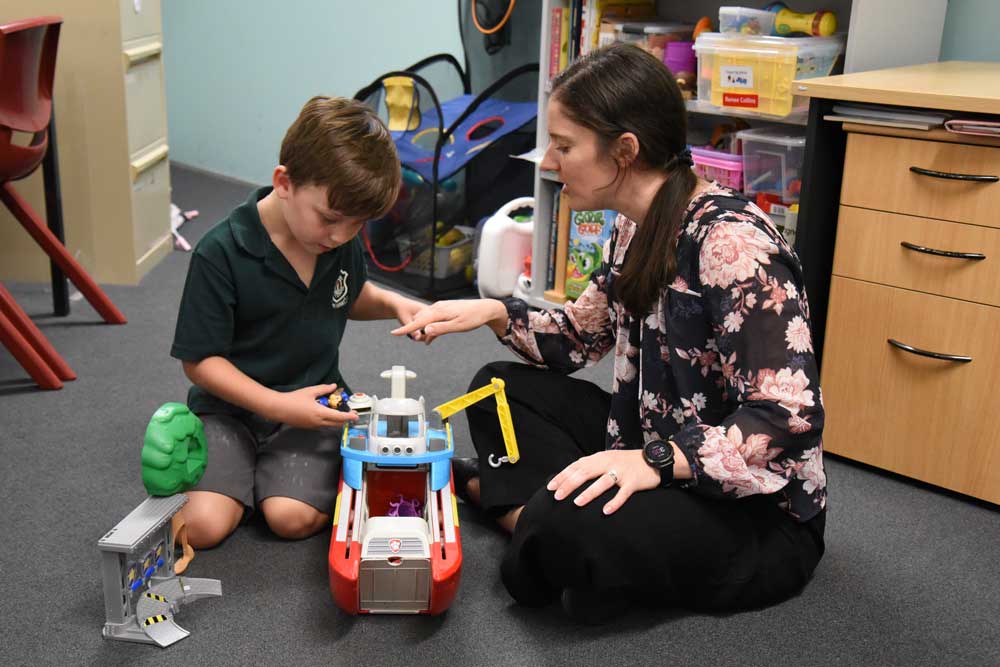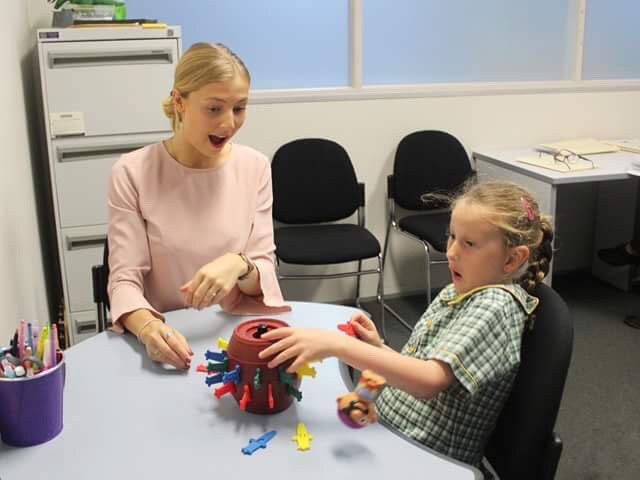
You’re assessing a primary school student. The teacher has informed the parent that the child has difficulty following instructions in class and the parents have similar concerns at home. During the language assessment, the student struggles on a subtest measuring their ability to follow directions. You recommend therapy and write a goal something like: “CLIENT will follow 3-step directions with 2 modifiers with 80% accuracy.”
It feels logical. It aligns with parent & teacher priorities. It’s measurable. It’s common practice – everyone else has these goals.
But is it best practice?
Why Multi-Step Direction Goals Are So Common
Goals targeting 2- and 3-step directions are nearly ubiquitous in speech therapy with school-aged clients. Several factors contribute to this:
-
Standardized Testing
Multi-step directions frequently appear on language assessments. Because they serve as useful indicators of language disorder severity, they often get copied directly into therapy goals — even though assessment tasks are not meant to become intervention targets.
-
Tradition
Clinical practice is often replicated because “it’s what we’ve always done.” If supervisors and colleagues write these goals, they begin to feel like the standard.
-
Parent and Teacher Priorities
When a child isn’t following instructions in class or at home, it understandably becomes a major concern. These goals appear functional and urgent.
-
Ease of Measurement
Following directions is observable and concrete. It lends itself to quick data collection — an attractive feature for busy clinicians.
-
Behaviourally-Based Therapy Models
These goals align neatly with drill-based, compliance-focused therapy approaches that have historically shaped much of our field.
When all of these forces converge, it creates a strong current. Swimming upstream takes intention.

The Problem: Following Directions Is Not a Single Skill
Following multi-step directions is complex. It is what we might call a pinnacle skill — success depends on multiple systems working together.
To follow a direction, a child needs:
✔ Motivation
There must be a reason to comply. Motivation is relational and contextual. Children may have competing drives — particularly those with strong autonomy needs.
✔ Executive Functioning
The child must:
- Shift attention
- Sustain attention
- Hold information in working memory
- Inhibit impulses
- Initiate and organize actions
That’s a significant cognitive load.
✔ Language Comprehension
The child must understand:
- Vocabulary (including temporal, quantity, and concept words)
- Morphology (e.g., -er, -est)
- Syntax (complex sentence structures, passive voice)
- Pragmatics (urgency, intent, relational meaning)
When a child fails to follow a direction, which of these systems broke down?
It’s often impossible to tell from simple accuracy data.
The Evidence Gap
Here’s the hard truth: There is no evidence that drilling multi-step directions improves underlying language comprehension. Just as practicing “brain games” may improve performance on that specific game without generalizing, drilling arbitrary 3-step commands does not necessarily translate to classroom participation.
So, not only is targeting multistep directions complex and multi-faceted but there is very little evidence to show it is effective.
Why These Goals Fall Short

Many clinicians report an “icky” feeling about these goals. That discomfort is often rooted in three key issues:
-
Mismatch Between Therapy and Function
Following an arbitrary 3-step command in therapy is not the same as meaningfully participating in classroom learning.
-
Opportunity Cost
Time spent drilling directions is time not spent targeting vocabulary, grammar, narrative skills, or executive function strategies — skills that actually underpin comprehension.
-
Compliance vs. Competence
It can be difficult to separate comprehension from compliance.
We must also consider the broader implications of teaching unquestioned obedience. Children — especially those with language disorders — need the ability to refuse and advocate for themselves.
Not following directions is not automatically evidence of a deficit. It may reflect:
- Developmentally typical autonomy
- Sensory dysregulation
- Executive functioning differences
- Relational factors
- Environmental demands exceeding support
A More Productive Path Forward
If a child struggles to follow directions, the solution is not necessarily better drilling.
Instead, we can:
-
Target Underlying Language Skills in Context
Support vocabulary, morphology, and syntax within meaningful academic tasks.
-
Teach Compensatory Strategies
Rehearsal and visualization strategies have demonstrated long-term gains, particularly when taught together.
-
Modify the Environment
This approach currently holds the strongest evidence base.
Accommodations may include:
- Simplifying or chunking instructions
- Providing visual supports
- Reducing distractions
- Ensuring attention before giving directions
- Teaching self-advocacy for clarification
Sometimes the most powerful intervention is adjusting the adult response rather than increasing child demand.
Rethinking Our Goals
The discomfort many of us feel about multi-step direction goals is worth listening to.
If the breakdown is linguistic, write a goal targeting the specific linguistic structure. If the challenge is executive functioning, write goals for strategy use and accommodations. If motivation and relational factors are at play, address connection and engagement.
When we zoom out and consider the whole child — language, cognition, context, and autonomy — we move toward intervention that is more functional, ethical, and aligned with current evidence